Saturday, January 31, 2015

Audio File #3: Getting Entangled in Invisibilia

Cover for "Entanglement" by Daniel Horowitz
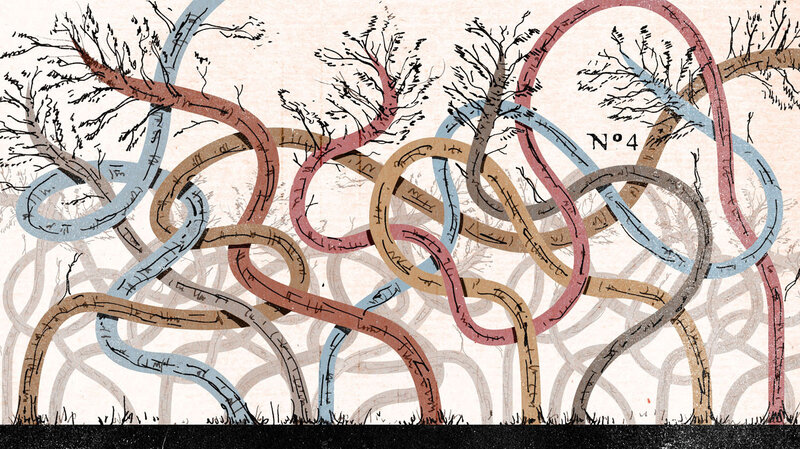
“Two things separated in space can be the same thing.” –Geoff Brumfiel, Entanglement

After the hit podcast Serial landed and enraptured a widening audience of audio fanatics, I think that a lot of people have been searching for new shows to fill the gap left behind by the conclusion of Serial season one. To this group—and to existing podcast aficionados—I present Invisibilia.

Invisibilia is the spiritual successor of Radiolab, and its production love-child along with This American Life. The two hosts, Alix Spiegel and Lulu Miller, are founding producers of This American Life and Radiolab, respectively, and NPR science reporters besides. Latin for “all the invisible things,” Invisibilia promises a weekly exploration of the invisible forces that shape human behavior. So far, four shows in, this means Spiegel and Miller are creating a surprisingly spiritual discussion rooted in cutting edge neuroscience about the psychology and brain biology behind how humans feel and act.

The first three episodes covered the power and intrigue of our very own thoughts; how to control your fear (and what happens when you feel none); and the profound, very real, effects of people’s expectations of the blind. Each is truly, almost alarmingly, excellent. Today, I want to cover the latest episode: Entanglement.

Lulu and Alix begin by visiting a physics lab at the University of Maryland to witness the creation of quantum entanglement, the physical phenomenon of linking two objects together at a deep level. Once entangled, if one particle is altered—even at a great physical distance from its partner—the other responds accordingly. It’s messy, and brushes up against our notions of causality and the fundamental limit of the speed of light, but it is very real. And quantum entanglement is the lead in to the equally bizarre and fascinating world of entanglement among people, how we are intimately tied to the people around us in conscious and unconscious ways.

The first story of entanglement takes Alix and Lulu to a woman, Amanda, and her family. Amanda experiences a very rare form of extreme empathy, called mirror-touch synesthesia. Synesthesia is the general term for relatively rare but well-documented cases when people experience a mixing of traditionally separate senses, like seeing colors in numbers or tasting sounds. Basically, synesthesia boils down to crossed wires in the brain, which ultimately integrates all of our senses into conscious experience. In some people, that integration is messier.

For Amanda, the very experience of seeing someone experience something triggers the subjective sense of that act within herself. When she was young, she realized that seeing someone get hugged felt like a hug, at a very real, physical level. A woman scratching her arm felt like a scratch. People chewing food felt like they were stuffing food in her own mouth. Pain also transferred across space. Experiencing all of this, and an intense level of emotional empathy as well, left Amanda drained every day, and even unsure of her own identity as she took on the feelings and mannerisms of those around her.

The neurological explanation of Amanda’s difficult condition relies on mirror neurons. Observed directly only in monkeys so far, mirror neurons fire both when observing an action and when doing it. They are a cellular explanation for empathy. Presumably, mirror neurons, or something much like them, cause Amanda’s sensory cortex to light up just when watching a stranger feel or do something. I will leave the engrossing and melancholic exploration of the effects of this overcharged empathy on Amanda and her family to the hosts. Suffice to say, it is not easy being so intimately wrapped up in the world.

The second story features psychology researchers Elaine Hatfield and Dick Rapson of the University of Hawaii and their studies on ‘emotional contagion,’ the phenomenon of mimicking the physical and emotional states of those around you. Unconsciously, we match the posture or speaking patterns of people we interact with. Lulu goes on to explain that even imperceptible patterns, like blinking or breathing, will become synchronized.

Emotional mimicry is at play here as well. Linked to microexpressions—unconscious, rapid-fire flashes of emotion—this kind of emotional empathy influences the mood of everyone you interact with. Filled with audio of old Candid Camera episodes and the meshwork of Elaine and Dick marveling at the subject of their studies, the story comes alive with emotion and a sense of wonder. The researchers explain the consequences of this sponge-like absorption of our environment’s emotional energy, which include a limit on our individuality. We cannot truly be isolated, emotionally contained individuals if we react so viscerally to the emotions around us. Like smokers who try to quit but still hang around smokers, all of us are influenced in obvious and subtle ways by the people we surround ourselves with.

Or as Lulu explains: “It's like without quite being aware of it, we are all one organism, a heaving, swirling organism contracting the feelings and thoughts of the people around us.”

There is a bonus story at the end about the greatest entanglement—the one with our mothers—that I won’t spoil. In their exploration of Amanda’s extreme empathy, and our commonplace experience of it, Lulu and Alix manage to weave an emotional hour of awe, sadness, and laughter. Their story-telling pedigrees, and science journalism chops, combine to create the best science show I know of since Radiolab.

The show can stretch credulity. This is clearly not an accident. Alix and Lulu want to stretch your mind to the border of science fiction, and then push you back just over the edge toward reality. They deliberately construct ridiculous claims—about the blind seeing or the material reality of thoughts—and then carefully lead you to that exact conclusion through their narrative. They may test the boundaries of accuracy with hyperbole, but the sense of curiosity and wonder they instill seems worth it.

I would be remiss if I did not mention the refreshing power of having two quick, smart women discuss science with a clear sense of awe, respect, and desire to learn and share. Although Lulu and Alix are journalists, not scientists, I expect the show could really impact our culture where women are still underrepresented in science and face a lack of role models for scientific curiosity. Not scientists, no, but Lulu Miller and Alix Spiegel have the scientific curiosity down, and we all benefit in Inivisibilia.


Wednesday, January 28, 2015

Keeping Spuds Safe--And Humans Too

Fortunately, potatoes are never quite as toxic as the alien carrots
in the Looney Tunes "Invasion of the Bunny Snatchers" episode
A team of Japanese scientists has published research that may help both protect potatoes from serious diseases and safeguard humans from poisonous spuds. The researchers, led by Dr. Kazui Saito, were able to identify a gene critical for making the toxic alkaloid chemicals that potatoes produce to protect themselves from pests. Although commonly-eaten varieties contain safe, low levels of these alkaloids, they are also more susceptible to certain major diseases. To combat infections, breeders want to crossbreed these safe spuds with disease-resistant—but poisonous—wild potato species without increasing the levels of toxic alkaloids in the potatoes we eat. Dr. Saito’s group has discovered a way to largely disable the production of these chemicals, opening up safer avenues to breed strong, resistant potatoes that do not make people sick.

Although normally safe, potatoes are serious contenders for the most toxic vegetable in the American diet. Potatoes, tomatoes, and eggplants are all members of the nightshade family, which produces a group of chemicals called steroidal glycoalkaloids to defend against pests. In small amounts, these chemicals may cause an upset stomach, but extremely high doses can lead to dizziness, hallucinations, and even death.

Human domestication long ago selected for potatoes with low levels of these alkaloids. But domestication also produces crops that cannot defend themselves as well against diseases—in particular, our efforts to make potatoes safer, larger, and tastier have impaired the spud’s ability to protect itself against late blight disease, the most damaging potato infection. Late blight led to starvation in Ireland in the 1840s, and today accounts for billions of dollars in lost productivity worldwide.

Crop breeders routinely scout out hearty wild relatives of our foods, seeking to breed in traits like disease resistance. For potatoes, scientists must ensure that borrowing beneficial traits from wild varieties does not increase the levels of steroidal glycoalkaloids above a safe threshold. One way to limit this risk is to reduce the production of these alkaloids in potatoes before breeding programs even start.

So Dr. Saito’s group set out to understand how potatoes make these chemicals in order to control and limit their production. Steroidal glycoalkaloids primarily consist of a steroid backbone, which is made from cholesterol. As a result, the scientists searched for genes in the potato genome that resembled a human gene that helps synthesize cholesterol. Although humans, peas, and rice have only one copy of the gene, potatoes have two—SSR1 and SSR2.

Having two similar genes is often a sign that the two copies have evolved to specialize. While most plants use a single gene to make cholesterol and other important chemicals like hormones, Dr. Saito and his colleagues reasoned that potatoes might have divided those two tasks between the two SSR genes.

To test this, they put the genes into yeast that made the chemical precursors of either cholesterol or plant hormones and measured what chemicals each SSR gene produced. They found that while SSR1 efficiently produced plant hormones, SSR2 excelled at making cholesterol. This specialization means that disabling SSR2 would shut down cholesterol and steroidal glycoalkaloid production without affecting SSR1’s synthesis of important hormones.

Scientists can add snippets of a plant’s own gene to activate a natural viral defense mechanism—a kind of plant immune system—and impair the native gene’s function. When the Japanese researchers did this with SSR2, alkaloid levels plummeted to a tenth their normal level, while the plants themselves grew just fine, a sign that hormones still functioned properly.

Another technology, called genome editing, can produce permanent errors in a specific gene, turning it off completely. The researchers added an editing protein that disrupted SSR2 and found that the alkaloid levels again dropped to a fraction of their normal amount. The editing protein can be removed in the next generation. This leaves only the precise changes dialed in by the scientists and 100 percent potato DNA, unlike most crop genetic modifications that add DNA from other species.  

The ability to produce specific new changes with the potato’s own DNA may reduce widespread concerns about genetically modified crops, which, although shown to be safe, are rejected by a large number of consumers.  This would be good news for scientists looking for new tools to improve potatoes and other foods.  Late blight and other diseases are ongoing scourges and the expanded toolbox for safely combating them provided by Dr. Saito’s group may help keep the world’s fourth-largest crop on a level playing field with these infections while keeping spuds safe.


[This news story served as part of my application to the AAAS Mass Media Fellowship]


Tuesday, January 13, 2015

A Divided St. Louis that Must Be Repaired

St. Louis is a divided region. In 1876, the City of St. Louis voted to separate from St. Louis County, defining a surprisingly small city center, barely a quarter the area of Chicago, and making it one of the few major independent cities in the United States. During the 1900s, the City was divided into a poor, largely black North City and a more affluent South City. St. Louis was split again—not geographically but socially—in August when Michael Brown was shot and killed in Ferguson, a suburb in St. Louis County. What happened in Ferguson this summer was likely the inevitable result of the divisions with which St. Louis has never grappled. What is not inevitable is that St. Louis will seize this opportunity to heal these fractures. To do so, the region must recognize how these divisions were deliberately constructed, and pursue the intentional dismantling of their consequences.

A racially-divided St. Louis was created throughout the twentieth century. The first half of the century was a story of growth and progress. In 1904, St. Louis hosted the first Olympics on American soil, alongside a World’s Fair. By 1950, St. Louis was the eighth-largest city in the country. Accompanying this rise, the city’s existing segregation into black and white was formalized.  Redlining—the then-legal process of restricting housing by race—defined select neighborhoods where blacks were allowed to rent or buy. Existing black neighborhoods were considered a loss; white neighborhoods were protected from change. Even after redlining was officially prohibited, realtors and municipal decision-makers worked to maintain the same outcome: racially-restricted housing.

Eventually, a large portion of North City was set aside for black residents, who were barred from most other areas by formal and informal housing covenants, including the increasingly affluent County suburbs. As the City’s population declined sharply after World War II, spurred by rampant white flight, the urban core was hollowed out. The same pattern hit many cities, especially other Midwestern industrial centers like Detroit, Cleveland, and Chicago. Housing restrictions kept black citizens from fleeing the blight, further concentrating poverty within the majority-black North City.

Even well-meaning efforts reinforced segregation and poverty. The Pruitt-Igoe public housing projects, built in the 1950s, were hailed as a progressive solution to the problems of slums and urban decay, and the city leveled several blocks in North City to build the segregated high-rise buildings. They quickly fell into disrepair and attracted crime, deteriorating without financial support from the City to ensure upkeep. Barely two decades after construction, having cost hundreds of millions in today’s dollars, the failed projects were demolished. The neighborhoods cleared to build Pruitt-Igoe never recovered. Those in power did not control changing economies or demographic trends, but they did ensure that the worst effects were felt by an increasingly marginalized black population. Today, the former site of Pruitt-Igoe is surrounded by blocks with only a few houses on each street. North city is devastated: it was designed to fail, and it did.  The echoes of this mid-1900s segregationist policy were felt in Ferguson this past summer.

When the City voted to separate from the County in 1876, City residents were worried about the poorer, sparser County siphoning off tax revenue. As suburbanization boosted the County’s population and wealth, this separation increasingly hurt the City’s financial and social position. And divisions continued: dozens of cities incorporated within St. Louis County during the twentieth century, a process of balkanization that created the 91 distinct municipalities that exist today. One ‘city’ has a population of 12. This creates a complicated map of overlapping taxes, school districts, and police.

The very real effects of these confusing divisions were seen this past August. A Ferguson (population: 21,000, 67% black, North County) police officer who lived in Crestwood (population: 12,000, 94% white, South County) shot Michael Brown. The investigation was handed over to County Police, an overarching force that has authority over, but does not patrol, Ferguson. The County Prosecutor’s office in Clayton (population: 16,000, 78% white, West County) oversaw the grand jury proceedings. Calls for everything from body cameras on police to altered hiring practices have to contend with the political realities of this municipal patchwork.

After housing restrictions were lifted, black flight followed older waves of white flight, predominantly into North County, to escape the decay of North City. Cities like Ferguson and Florissant, northwest of the city limits, shifted from largely white suburbs to racially-mixed, but poorly-integrated, communities. City councils and police departments, staffed largely by officers from other towns, did not shift accordingly. This is the context in which Ferguson became a household name.  In Ferguson, newer black residents concentrated in middling apartment complexes in one corner of the city. Police calls and patrols became more common in the area. Tensions increased between police and the apartment residents. Darren Wilson and Michael Brown interacted for all of ninety seconds before Brown was dead and Wilson went into hiding, but the forces that brought them together on August 9th were slowly churning for decades.

Since that day, the world has watched waves of unrest and violence. Riot gear, arson, and tear gas made headlines on the warm nights of August and again following the grand jury’s decision not to indict Wilson in November. News networks broadcasted burning cop cars side-by-side with President Obama’s appeals for calm. Yet despite the endless visuals of violence and the portrait of a community seeming to self-destruct on national television, much has happened in St. Louis out of sight of the cameras that shows a first step toward progress.

In Ferguson, volunteers came out each morning to clean up the debris from protests the night before. With the start of the school year delayed, donations of school supplies flooded in to churches and community centers, and libraries offered free lessons for children. Peace vigils sprang up in neighborhoods around the region. Protests marched through downtown St. Louis at the foot of the iconic Arch to call for peace and change. Universities assembled panels of experts in law, policing, and civil rights to provide context and information. Antonio French, a North City alderman, founded #HealSTL, a social media volunteer organization, and opened a storefront in Ferguson to coordinate long-term efforts. Missouri Governor Jay Nixon formed the independent Ferguson Commission—whose members range from young black activists to police officers to clergy—which is charged with finding a path to a stronger region through communication and action.

When the grand jury declined to indict Darren Wilson, protests marched along South Grand, a strip of shops and ethnic restaurants at the center of South City, far from Ferguson, but a secondary epicenter of protests. Around a dozen windows were shattered and businesses rushed to board up damaged and undamaged storefronts alike in anticipation of more protests. Right away, the neighborhood associations put out a call for materials, artists, and volunteers to decorate the plywood. Hundreds of people came out all day and night to paint images and words of support, turning a symbol of a broken community into uplifting messages of healing and love. Rather than exist for weeks as a boarded up ghost town, South Grand was transformed into an impromptu art walk. Few such events grabbed national attention, but they have galvanized St. Louis communities and brought a shaken populace together in the wake of tragedy. They seemed to begin the slow—painfully slow—process of healing.

No one can know if St. Louis will face the aftermath of the events in Ferguson with the resolve to address the long-standing divides that culminated in Brown’s death. Protests last weeks or months. Progress takes years and decades. The Ferguson Commission is encouraging dialogue and new ideas while the conversations St. Louisans have with each other every day open new channels of communication over old separations. This fractured and segregated city took decades of concerted effort and troubling economic forces to create.  St. Louis now requires the deliberate interventions of many to repair itself and move toward a community that is brought together as purposefully as it has been divided.

[This essay served as part of my application to the AAAS Mass Media Fellowship]


Tuesday, December 30, 2014

A Mathematical Explanation Why Valentine's Day Might Not Suck


We have yet to ring in the new year, but in anticipation of other disappointing holidays to come (seriously, isn't New Years set up to be anticlimactic?), let's consider Valentine's Day. Like New Years, it's meant to be a special occasion. Valentine's Day has the added pressure to create a particularly romantic day with your partner, a sure sign that reality may not meet expectations. Or maybe you shun the cliché chocolate and roses, but then the pressure of anti-Valentine's Day can be just as great! You have to wear sweatpants so hard while you care so little because it's all just a commercial holiday anyway, right?

Today in lab, my coworkers and I discovered what might be a seasonal proof to warm your icy, disappointed heart this February 14th. Just coming off the winter solstice, we were reflecting on how day length does not grow or shrink evenly throughout the year. Rather, following a sine curve, the day length barely budges around the solstices in June and December, while it rockets upward in spring or down in fall, at the equinoxes.

Just take a look at the sweet graph I drew to explain this. The horizontal axis corresponds to the day of the year, or time. The slope of the sine curve reflects the rate at which day length changes. A steeper portion of the line corresponds to times when daylight shrinks or expands at a faster clip from day to day. The fastest rate of change occurs at the autumnal equinox (AE) and the vernal equinox (VE). The peak and trough, at the summer solstice (SS) and winter solstice (WS) are flatter, meaning the day length doesn't change as quickly. Having just experienced the winter solstice a week ago, we are, sadly, at the bottom of the graph.

Given the continuous nature of the increases in daylight, when will we subjectively experience a slow thawing from winter darkness? By the vernal equinox, the days will be as long as nights and we will clearly have sensed the earlier sunrises and later sunsets. That is three months from now though, or about 90 days. Maybe halfway to the vernal equinox, 45 days from now, we will remark to our coworkers and spouse "Hey! It's staying lighter out now, isn't it?"

45 days from today is February 15th. A little rounding in either direction and I will make the bold prediction that come Valentine's Day, February 14th, you may be alone, your partner may have disappointed you, boxed chocolate may still taste terrible and roses may still have their thorns, but you'll probably wake up that day and think, "Well, at least it's not as dark as it has been." Comforting, right? An extra hour and a half of daylight can make up for so many of life's disappointments.


(The graph on the bottom is what we would expect day length changes to look like if it was a constant increase or decrease every day of the year, simply reversing at the solstices. The brackets on the main graph show how roughly equal periods of time (distance in the horizontal direction) leads to small changes in day length near the solstices, but big swings near the equinoxes.)


Sunday, December 14, 2014

Healing Through Art

Three weeks ago, a Grand Jury declined to indict Officer Darren Wilson in the shooting death of Michael Brown. Witness accounts differ in the level of aggression Brown displayed toward Wilson, but he was unarmed and did not earn a death sentence by his actions.

As anticipated—and arguably egged on by a frenzied media presence and worsened by prosecutor Robert McCulloch’s timing and tone—planned demonstrations and protests quickly turned into rioting and arson along Ferguson’s roads. Cars burned alongside the infamous split-screen image of President Obama calling for calm.

Following the shooting of Vonderitt Myers in the Shaw neighborhood, a smaller epicenter of demonstrations in the previous months has been south city, where I live. Marching up and down Grand, the major thoroughfare, protests were peaceful before I went to bed Monday night. However, I woke up to news of busted windows up and down the South Grand district of shops and restaurants a block from my house. Broken glass is not comparable to unequally applied justice or racial inequities or ongoing mistrust between police and the communities they serve. But it does represent fractured communities, scare people away from our neighborhood, and distract from efforts to make progress on issues brought up by Brown’s death.

So I was lifted up as the neighborhood associations in south city put out a call for materials and volunteers to decorate the plywood that covered broken windows and protected whole ones from further damage. Hundreds of artists and neighbors came to paint the plywood boards, turning a symbol of broken communities into uplifting messages of healing and community. Rather than exist for a week or more as a boarded up ghost town, South Grand was transformed into an impromptu art walk.

I walked around to snap pictures and thank the people who were painting. I was waiting to join a community meeting at the new pocket park on Grand where local leaders and aldermen would speak and neighbors would chalk messages of love for St. Louis. Here are the pictures I took.

The boards are starting to come down. It is peaceful at night in my neighborhood now. But that should not be permission to look away and ignore what Brown’s death has brought to the forefront. I do not believe that we need to break our communities to have them heal stronger, like a bone. But I do know that to let these problems fester unaddressed will lead to further heartache and greater problems in the future. So let us move forward and heal not just the symptoms but the underlying rot so we can have stronger and healthier communities.

See the rest of the pictures after the break.


Sunday, November 23, 2014

Biology, Everywhere

Electron Micrograph of Pollen
Biology is everywhere.

I needed to drop off some Arabidopsis plants with Robyn Roth, an electron microscopist in the Department of Cell Biology and Physiology at the Washington University Medical School. She is helping us peer inside pollen that is chilled instantly in liquid helium--just four degrees above absolute zero--so that the living cell is frozen in time. That way, we can see how pollen is structured before it has a chance to touch water and reanimate.


Walking through the lab, brimming with tanks of liquid nitrogen, potent solvents and specialized tools for dissecting fixed samples, I noticed the phone on the wall. Sitting innocuously in the middle of this equipment that allows us to peer inside (once) living cells was a simple pattern, a right-handed helix from the coiled phone cord.

DNA. The famous, infamous, structure of the repository of life's information. The 1962 Nobel Prize. The perfectly obvious, in hindsight, mechanism for both replicating itself and for translating the information from the four bases, A, T, C, G, into the building blocks of proteins, three letters at a time. The right-handed double helix is all of these things.

And today, it's how the phone cord coiled on itself. I pointed this out to Robyn and then we both went on with our days, where our work pushes just a little bit further into understanding all of what this simple and beautiful structure can create in every living thing around us.

Monday, November 10, 2014

Pollen in the Windy City

The view from outside the lab


I went to Chicago to figure out how pollen senses the world around it.

My colleagues and I want to understand how plants sense and respond to mechanical force. One might think that we have this figured out for all kinds of creatures, but really we don’t. We kind of have no idea how animal nerves sense touch. We think we have a good idea of how hearing works, but we could end up being quite wrong.

In plants, we know even less. Plants are really sensitive to gravity, touch, and all kinds of forces, we just don’t have a good idea of how they really perceive them and change their behavior appropriately. One way to do this is to use an ion channel that opens and closes based on pressure: a mechanosensitive ion channel.

That’s how hearing works, converting air pressure into electricity through an ion channel. A pressure wave—sound—in air enters the ear and bends a molecular lever so that an ion channel opens. Instantly, charged particles can flow through the channel, millions of them every second, and zzzp this makes a little electrical pulse that our brains can decode into sound. That is a mechanosensitive ion channel at work, and there is one in pollen and we do not know why.

My plants packed into my car for the trip
(We always think of electrical impulses as the workings of nerves. The cool thing is, even without nerves, these signals can be interpreted by cells and used to change behavior. Ions also play a big role in controlling how water flows, and we think that is what might be happening in my pollen.)

My pollen has a protein that looks like a mechanosensitive ion channel, but we don’t really know if it functions like that. So, I went to Chicago to find out.

Dr. Paul Malchow has equipment we don’t, namely an electrode that is extremely sensitive and can distinguish between different ions. By using a putty that only lets individual ions through—hydrogen, calcium, chloride, or the like—the voltage that the electrode measures near a cell can be linked directly to the concentration of ions there. The tool I brought along was a mutant plant, one that’s missing our potential ion channel. So, if I can see a difference in the flow of ions near pollen grains with and without this channel, we’d have good evidence that this channel is functional and can control how ions flow around pollen.

An electrode measuring ions near pollen
Does that tell us how pollen senses the world around it? No, not exactly. It’s just a small piece of the puzzle that we rearrange and try to piece together every week. If the channel does work like we expect, then we can try to figure out what forces it responds to in pollen, why ion flow is so important. If it is a dud, then we have to think harder about why pollen has this imposter ion channel at all, and what exactly it’s doing, and whether that has anything to do with mechanical force. We just don’t know. I don’t even have the answer from the electrode data yet, that alone can be hard to interpret.  

That may sound unsatisfying. It can certainly be frustrating. But it’s never boring, because every week my mentor and I reconsider everything we think we know about our pollen, about the evolution of these channels, about what pollen needs to respond to in order to be successful. It’s a little arcane, but it’s just a tiny piece of the puzzle for figuring out how plants respond so elegantly to the world they inhabit, twisting and turning to find nutrients and light, avoiding herbivores and pests. Playing a part in painting this picture of how plants are themselves really is satisfying.

So I went to Chicago, largely ignoring this beautiful city to huddle in a cold laboratory watching videos of pollen being prodded with electrodes. Happily.